01 / PAINTING
◒
Moments
Scenes from daily life become lasting impressions through the artist's personal visual language.
A visual journey through the work of artist and inventor David W. Copplestone: paintings that celebrate the world as it is, designs that imagine what might be, and games that turn ideas into shared experiences.
A body of work · A lifetime experience
Begin the journeyExplore the source archive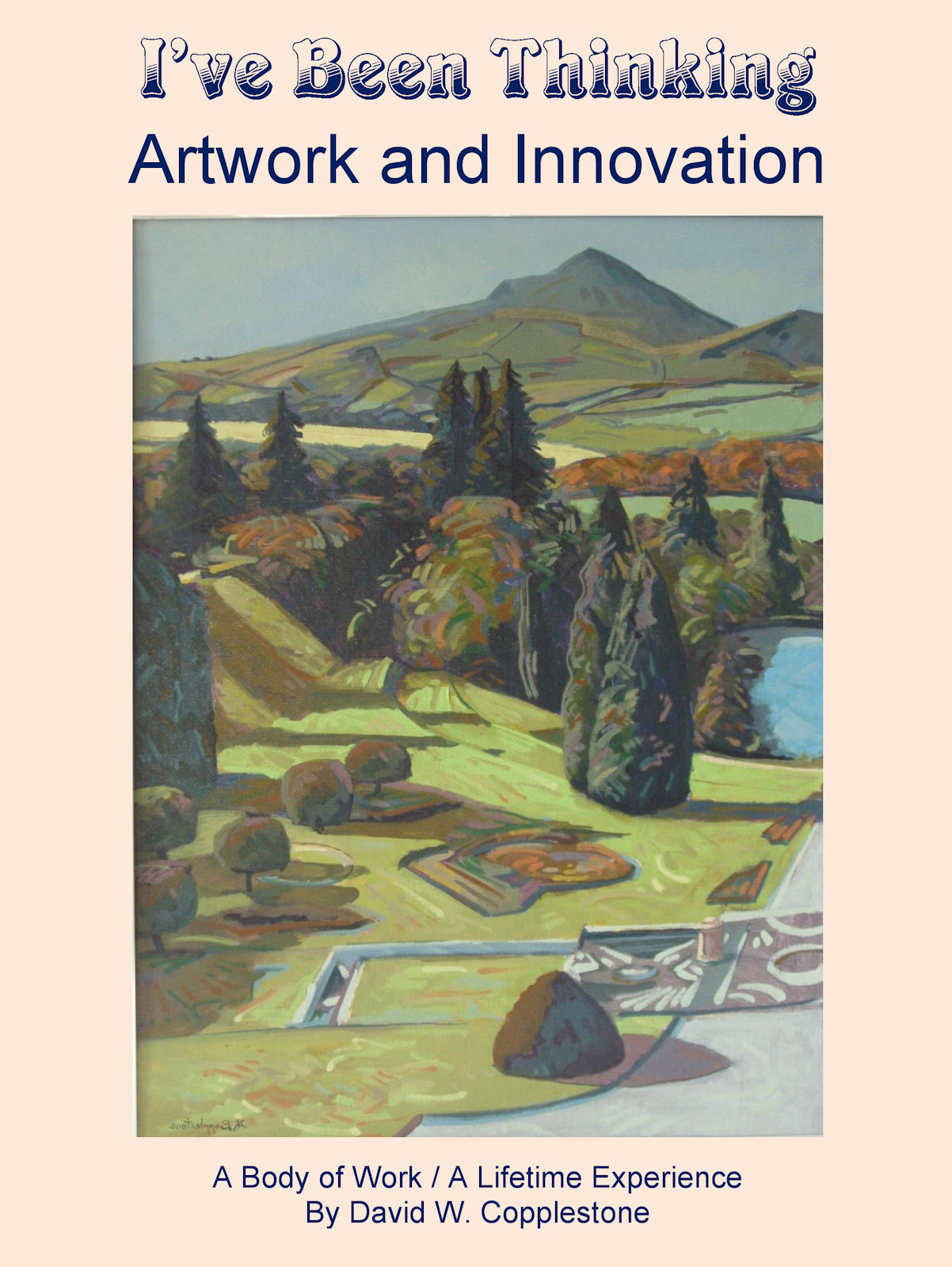
Love it. Nurture it. Help it develop and grow. Believe in it, and share it with the world so it can realize its potential. An idea begins as a possibility, but it becomes meaningful through attention, persistence, and the willingness to let others experience it.
This expanded web edition follows the threads that connect a wide-ranging creative life: looking closely, drawing what is seen, wondering what could be different, building and testing, and sharing the result. Art and invention may seem like separate pursuits, but both begin with curiosity. Both ask us to pay attention. Both reward the person willing to keep working after the first idea appears.
The original book is a collection of projects, experiments, products, stories, and reflections. Rather than treating each as an isolated object, this edition explores the connections between them—the recurring desire to make something, understand it, and give it a life beyond the studio.
Before making comes looking. A landscape, a street, a face, a musical performance, or an ordinary passing moment can become remarkable when we give it our full attention. Painting is one way of keeping that attention alive.
The paintings are records of experience and interpretation. Color, shape, and line do more than describe a subject: they convey the feeling of being there, the rhythm of a place, or the character of a moment.
From landscapes and city scenes to people, music, movement, and family, the work celebrates the world as something endlessly worth observing. The image is not simply a copy of what is in front of the artist. It is what the artist has noticed, remembered, and chosen to share.
View oil paintingsScenes from daily life become lasting impressions through the artist's personal visual language.
Inventive drawings let imagination take flight, joining technical curiosity with the freedom of art.
A simple line can become a study in rhythm, structure, movement, and the relationship between parts.
The creative process does not stop at a finished picture. A thought can become a drawing; a drawing can become a model; a model can become a thing someone can hold, use, play with, or discover.
Curiosity is the engine running beneath this body of work. What if an everyday object worked differently? What if a game could also be a sculpture? What if a new design could invite two strangers to laugh together?
Ideas rarely arrive as finished answers. They need to be sketched, reconsidered, tested, and reshaped. A useful idea is not protected from reality; it is brought into contact with reality so it can improve.
The process is a conversation between imagination and experience. Each attempt teaches something. A wrong turn may reveal a better direction. A small detail may become the key to the whole design.
Read “The Idea / The Dream”Notice a possibility that other people might pass by.
Give the idea form, test it, and learn from what happens.
Let the idea leave the studio and become part of someone else's experience.
A design becomes more than a thought when it has to work in the real world. Materials, dimensions, balance, durability, assembly, and use all ask practical questions of the imagination.
Concept drawings and engineering documents reveal a less visible side of creativity: the patience of working out how something is made. A finished product can look simple, but its simplicity may be the result of many decisions and revisions.
Specifications and drawings are not the opposite of art. They are another language for expressing an idea clearly enough that it can be built, understood, and used. They connect the initial spark to the finished object.
Across the archive, the artist's imaginative side and the inventor's practical side meet repeatedly. The work moves between free exploration and exacting detail, between the open question and the precise measurement.
Explore engineers' drawingsGames turn thought into action. They create a small world with a challenge, a set of possibilities, and a reason to try again. The result can be concentration, laughter, friendly competition, or the pleasure of figuring something out together.
For a designer, a game is a carefully shaped experience. The rules must be understandable, the challenge must feel inviting, and the interaction should reward curiosity. A game works best when people want to participate before they have fully worked out how to succeed.
Play also makes ideas social. People watch one another, exchange suggestions, celebrate a good attempt, and invent their own ways of practicing. A well-designed game can make a public space feel more welcoming because it gives people a natural reason to gather.
Copplestone's game projects explore different forms of this invitation—from physical skill and timing to strategy, pattern recognition, and the shared delight of a surprising result.
A board-game concept built around investment strategy, choices, and the consequences of decisions.
Explore LOTSA dice game that brings pattern, probability, anticipation, and a little suspense to the table.
Visit Copplestone GamesA golf-training product shaped around practice, repetition, and developing a more consistent putting stroke.
Explore Putting RailsOrbiter brings together a physical puzzle, an experiment in motion, and an invitation to participate. Its unusual geometry makes a familiar ring-toss idea feel new: the player must observe, adjust, and learn through movement.
Orbiter developed from sustained experimentation with ring-toss concepts. The angled posts change the challenge from a simple throw into a problem of trajectory, timing, and feel. The player begins by watching, then tries a swing, notices what happened, and makes an adjustment.
The experience can be described through physics—gravity, pendulum motion, momentum, angles, and timing—but the first lesson is often intuitive. You learn by doing. Each attempt provides feedback, and progress comes from connecting observation to action.
Orbiter is also conceived as functional art and public interaction. It can attract a passerby, start a conversation, and invite people of different ages and abilities to take turns. In that sense, the game is not only about landing the ring. It is about the shared experience around the attempt.
Watch the path. Notice how the object moves and how the structure shapes the challenge.
Try again with a change in timing, direction, or force. Learn from every swing.
Give someone else a turn. A private puzzle becomes a social experience.
One of Orbiter's central ideas is that the game can carry more than one meaning at once: a brainteaser by description, a peace symbol by design, and a search for understanding by nature. Every successful or unsuccessful swing becomes part of a small experiment in attention and possibility.
Not every idea needs to be large to be meaningful. A small object can carry a message, become a personal emblem, or remind someone to approach the day with energy and optimism.
Shoebops are shoelace accessories conceived as cheerful symbols of optimism, health, and energy. Their rainbow palette gives them an instantly recognizable visual identity, while the smiling form turns a small detail on a shoe into a friendly expression.
The concept connects design with storytelling: color is not only decoration, but a way to communicate mood and meaning. A playful object can become a reminder to move, explore, and carry a little brightness into everyday life.
Like the games, Shoebops begin with a simple invitation. Notice it. Smile. Share the idea with someone else.
Explore the Shoebops storyA creative archive is rarely a straight line. It is more like a landscape of paths: some lead to finished products, some to experiments, some to drawings, and others to questions that remain open.
Drawing becomes a space for imagination, from exploratory design to expressive color and visual play.
Open airship designsThe idea is a beginning, not a conclusion. It asks to be explored, developed, and given room to grow.
Read the reflectionGames and products show what happens when an abstract possibility is shaped for real-world use.
View product catalogAcross these different projects, a recurring pattern emerges: observe something closely, imagine an alternative, give the alternative a form, test that form, and invite other people to respond. The subject changes, but the creative habit remains.
The measure of a lifetime of creativity is not only the number of things made. It is also the experiences those things make possible: a conversation, a challenge, a new question, a moment of delight.
Paintings preserve a way of seeing. Designs capture possibilities. Games give people something to do together. Historical pages, manufacturing drawings, and reflections reveal the persistence behind the finished objects.
A website can serve as a studio with its doors open: a place where the work can be observed, experienced, revisited, and appreciated. The archive becomes a record of what has been made and an invitation to discover what might come next.
Sharing is not an afterthought. It is how a work finds its audience and how an idea gains a life beyond its creator. Once shared, an idea can be interpreted, tried, adapted, and passed along.
Early sketches, source documents, product histories, reflections, and specifications help tell the story behind a finished object. They show that creative work is a process over time, shaped by persistence as much as inspiration.
A possibility catches the eye. It might be a visual relationship, a movement, a puzzle, or a familiar object that could work in a new way.
Sketches and models give the thought a form that can be examined. The idea becomes more specific, and new questions appear.
Dimensions, materials, and practical requirements turn an exciting thought into something that can be made and used.
A painting is viewed, a game is played, a product is tried, or a story is read. The idea reaches beyond the person who created it.
The title is also a practice. Keep looking. Keep asking questions. Keep trying things that might not work the first time. Keep the ideas that make you curious, and give them a chance to grow.
Art and invention are ways of engaging with the world. One may begin with a brushstroke, another with a mechanical question, a game rule, a product sketch, or a fleeting thought. Each can become a journey from possibility to experience.
The work collected here is an invitation to follow that journey—not as a closed story, but as a continuing process. There will always be another image to notice, another problem to solve, another game to play, another idea worth sharing.
This expanded illustrated edition is a guided companion to the original 2023 collection. Use the source documents below to explore the artwork, concepts, product histories, and reflections in greater detail.
Links open source material hosted on CopplestoneGames.com and require an internet connection. This web edition is an expanded interpretive companion, not a verbatim transcription of every page in the original eBook. All original work remains attributed to David W. Copplestone.